Editable Bank Balance Tracker Sheet 1: A Practical Design Asset
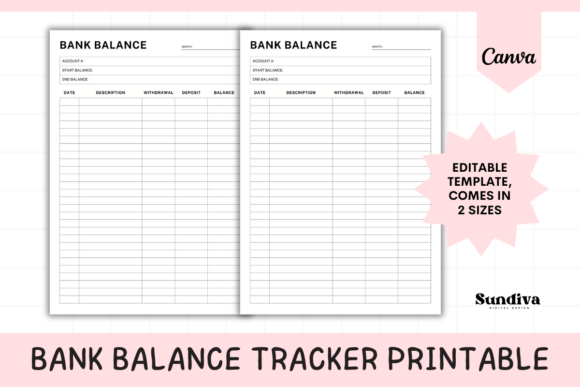
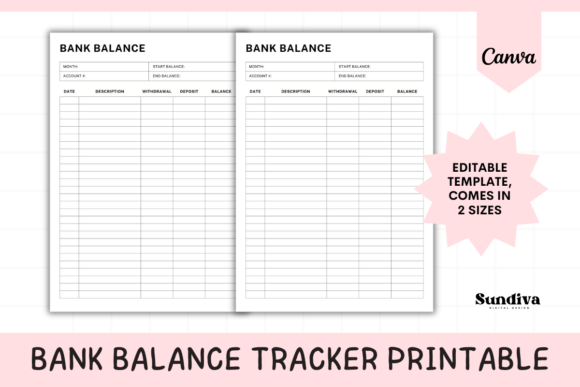
Financial clarity is a design challenge as much as it is a numerical one. We often treat spreadsheets and ledgers as purely functional, but their visual structure directly impacts our ability to process information quickly and accurately. The Editable Bank Balance Tracker Sheet 1 approaches this with a designer's mindset. It’s not just a grid for numbers; it's a thoughtfully arranged template where every element serves a purpose. The layout uses clean lines, ample white space, and a clear visual hierarchy to guide your eye from account summaries to individual transaction details. This isn't about flashy graphics; it's about creating a calm, organized environment for your financial data, which can reduce the stress often associated with money management.
This template functions like a well-crafted display font for your numbers—designed to be immediately legible at a glance. Its personality is one of quiet confidence and professionalism. The style is modern and minimalist, avoiding unnecessary ornamentation that could clutter the page. This overall appeal lies in its versatility. It feels equally at home on a creative freelancer's desk next to a sketchbook as it does in a small business owner's office filing cabinet. It bridges the gap between personal budgeting and formal business accounting without feeling out of place in either context.
Where This Template Fits Best: From Personal Budgets to Brand Identity
The true strength of the Editable Bank Balance Tracker Sheet 1 is its adaptability across a wide range of projects. For the individual, it's a cornerstone of personal finance management. Imagine using it to track savings goals for a major purchase or monitoring multiple checking and savings accounts. Its digital-editable nature in Canva means you can update it on your phone or computer, making it a living document rather than a static piece of paper. For entrepreneurs and small business owners, it becomes a vital design asset for basic accounting. It can help separate personal and business finances, track project-specific expenses, or monitor cash flow from various revenue streams.
In a broader branding or marketing context, consistency is key. While you wouldn't use this sheet as part of your public-facing brand identity, its internal use supports the operational backbone that makes a brand run smoothly. A designer or content creator who keeps meticulous financial records is better positioned to make strategic decisions about investing in new creative font licenses, premium software, or marketing campaigns. The template's clean aesthetic mirrors the professionalism you aim to project in your client work. Using a well-organized tool like this reinforces a mindset of precision and attention to detail, qualities that translate directly into better editorial design, packaging design, or social media graphics.
Practical Guidance: Evaluating and Implementing the Tracker
Choosing to use the Editable Bank Balance Tracker Sheet 1 is straightforward, but getting the most from it requires a bit of forethought. First, consider your primary need. Are you tracking a single personal account, or do you need to monitor three business accounts and a line of credit? The template's structure is designed to be customizable, so you can duplicate sections or adjust headings to fit your specific scenario. Before committing all your data, take time to test the layout. Enter a few sample transactions. Does the flow feel intuitive? Can you quickly find the information you need? This is the equivalent of testing font pairings—you need to see how the components work together in practice.
When you open the template via the provided PDF link, you'll find it in two standard sizes: US Letter (8.5" x 11") and A4. This is crucial for both digital and print use. If you plan to print it, ensure the size matches your local paper standard. For purely digital use, the Canva platform allows for easy resizing if needed. A key piece of advice: while a computer is recommended for editing due to the larger screen real estate, the Canva mobile app is perfectly capable of making quick updates. This flexibility is a significant advantage over static PDF forms or basic spreadsheet software.
Remember, this is a digital product only. You are purchasing access to a customizable template file, not a physical binder or printed sheets. This model offers tremendous value, as you can print as many copies as you need, year after year, and always have the master file to reset or modify. The instructions within the PDF are your guide to unlocking the template's full potential. Treat it not as a rigid form, but as a starting point—a premium font for your financial narrative that you can adapt and style to tell your own story of fiscal organization and progress.